 Add to Chrome
 Add to Firefox
 Add to Edge
MMG2Skill: Can Agents Distill In-the-Wild Guides into Self-Evolving Skills?
Jun 01, 2026
Abundant procedural knowledge on the Web holds great potential for helping agents solve long-horizon tasks. However, such knowledge is often multimodal, heterogeneous, noisy, and implicitly assumes human executors, making it difficult to use directly as the skills required by agents. To bridge the gap between human-oriented guides and agent-executable skills, we formalize this problem as guide-to-skill learning: converting in-the-wild guides into executable skills and continuously improving them from trajectories observable to the agent. To evaluate the capability of existing agents on this task, we introduce MMG2Skill-Bench, the first benchmark designed for this problem. We further propose MMG2Skill, a closed-loop framework that compiles guides into editable skills, conditions a fixed vision-language model (VLM) agent on these skills during execution, and revises the skills from trajectory-level root-cause feedback without using benchmark scores. Across GUI control, open-ended gameplay, and strategic card play with six VLM backbones, MMG2Skill consistently outperforms vanilla baseline agents in every model-domain setting, achieving macro-average gains of +12.8 to +25.3 percentage points across backbones. Ablation studies show that directly prompting agents with raw guides can degrade performance, while both structured skill construction and trajectory-driven revision are necessary for the observed improvements. On success-inferable tasks, analyzer-based early stopping further prevents late-stage performance regressions and saves 25%-53% of attempts when the success signal is properly calibrated.

ChartAct: A Benchmark for Dynamic Chart Understanding
May 28, 2026Charts are widely used to present complex data for analysis and decision making. Existing chart understanding benchmarks mainly focus on static charts, but real-world charts are often dynamic and interactive. Key information may only appear after actions such as hovering, clicking, zooming, or dragging. Dynamic chart understanding therefore requires models to identify visible content, choose proper interactions, and reason over changing chart states. To evaluate this ability, we propose ChartAct, an interactive benchmark for dynamic chart understanding. ChartAct collects and filters 673 dynamic charts from 8 real chart websites, covers 7 common chart types, and constructs 1,440 high-quality question-answer samples. Each sample is instantiated in two environments, Dynamic Chart and Dashboard Chart, to evaluate dynamic chart understanding under different contexts. Based on ChartAct, we systematically evaluate 11 advanced multimodal models and GUI agents. Experimental results show that existing models still have clear limitations in dynamic chart understanding. The strongest model, Claude-Opus-4.7, achieves an average success rate of 84.5\%, while most models remain below 60\%. We also conduct detailed failure attribution and case analysis. ChartAct provides a new benchmark for studying chart understanding in real interactive environments. Codes at https://github.com/wulin-wulin/OSWorld_Chart
Dual-Dimensional Consistency: Balancing Budget and Quality in Adaptive Inference-Time Scaling
May 14, 2026Large Language Models (LLMs) have demonstrated remarkable abilities in reasoning. However, maximizing their potential through inference-time scaling faces challenges in trade-off between sampling budget and reasoning quality. Current strategies remain inefficient as they typically treat sampling width and depth as orthogonal objectives, where width consensus methods risk reinforcing hallucinations, while depth pruning mechanisms prematurely truncate complex yet valid reasoning chains. Therefore, we propose Dual-Dimensional Consistency (DDC), a unified framework that bridges path quality with adaptive termination. By coupling Confidence-Weighted Bayesian protocol with a Trend-Aware Stratified Pruning, our method ensures that computational resources are concentrated on high quality reasoning paths, filtering hallucinations while accelerating consensus. Evaluations across five benchmarks demonstrate that this approach reduces token consumption by over 10 times while maintaining or exceeding the accuracy of strong baselines across various LLMs.
Agentic Harness Engineering: Observability-Driven Automatic Evolution of Coding-Agent Harnesses
Apr 28, 2026Harnesses have become a central determinant of coding-agent performance, shaping how models interact with repositories, tools, and execution environments. Yet automating harness engineering is hard: a heterogeneous action space, sparse and noisy evaluation signal, multi-million-token trajectories, and edits whose effect is hard to attribute to the next round's outcomes. We introduce Agentic Harness Engineering (AHE), a framework that automates harness-level evolution by instrumenting the three stages of any engineering loop (component editing, trajectory inspection, and decision making) with matched observability pillars: (1) component observability gives every editable harness component a file-level representation so the action space is explicit and revertible; (2) experience observability distills millions of raw trajectory tokens into a layered, drill-down evidence corpus that an evolving agent can actually consume; and (3) decision observability pairs every edit with a self-declared prediction, later verified against the next round's task-level outcomes. Together, these pillars turn every edit into a falsifiable contract, so harness evolution proceeds autonomously without collapsing into trial-and-error. Empirically, ten AHE iterations lift pass@1 on Terminal-Bench 2 from 69.7% to 77.0%, surpassing the human-designed harness Codex-CLI (71.9%) and the self-evolving baselines ACE and TF-GRPO. The frozen harness transfers without re-evolution: on SWE-bench-verified it tops aggregate success at 12% fewer tokens than the seed, and on Terminal-Bench 2 it yields +5.1 to +10.1pp cross-family gains across three alternate model families, indicating the evolved components encode general engineering experience rather than benchmark-specific tuning. These results position observability-driven evolution as a practical pathway to keep coding-agent harnesses continually improving.
OpenMobile: Building Open Mobile Agents with Task and Trajectory Synthesis
Apr 16, 2026Mobile agents powered by vision-language models have demonstrated impressive capabilities in automating mobile tasks, with recent leading models achieving a marked performance leap, e.g., nearly 70% success on AndroidWorld. However, these systems keep their training data closed and remain opaque about their task and trajectory synthesis recipes. We present OpenMobile, an open-source framework that synthesizes high-quality task instructions and agent trajectories, with two key components: (1) The first is a scalable task synthesis pipeline that constructs a global environment memory from exploration, then leverages it to generate diverse and grounded instructions. and (2) a policy-switching strategy for trajectory rollout. By alternating between learner and expert models, it captures essential error-recovery data often missing in standard imitation learning. Agents trained on our data achieve competitive results across three dynamic mobile agent benchmarks: notably, our fine-tuned Qwen2.5-VL and Qwen3-VL reach 51.7% and 64.7% on AndroidWorld, far surpassing existing open-data approaches. Furthermore, we conduct transparent analyses on the overlap between our synthetic instructions and benchmark test sets, and verify that performance gains stem from broad functionality coverage rather than benchmark overfitting. We release data and code at https://njucckevin.github.io/openmobile/ to bridge the data gap and facilitate broader mobile agent research.
MM-Doc-R1: Training Agents for Long Document Visual Question Answering through Multi-turn Reinforcement Learning
Apr 15, 2026Conventional Retrieval-Augmented Generation (RAG) systems often struggle with complex multi-hop queries over long documents due to their single-pass retrieval. We introduce MM-Doc-R1, a novel framework that employs an agentic, vision-aware workflow to address long document visual question answering through iterative information discovery and synthesis. To incentivize the information seeking capabilities of our agents, we propose Similarity-based Policy Optimization (SPO), addressing baseline estimation bias in existing multi-turn reinforcement learning (RL) algorithms like GRPO. Our core insight is that in multi-turn RL, the more semantically similar two trajectories are, the more accurate their shared baseline estimation becomes. Leveraging this, SPO calculates a more precise baseline by similarity-weighted averaging of rewards across multiple trajectories, unlike GRPO which inappropriately applies the initial state's baseline to all intermediate states. This provides a more stable and accurate learning signal for our agents, leading to superior training performance that surpasses GRPO. Our experiments on the MMLongbench-Doc benchmark show that MM-Doc-R1 outperforms previous baselines by 10.4%. Furthermore, SPO demonstrates superior performance over GRPO, boosting results by 5.0% with Qwen3-8B and 6.1% with Qwen3-4B. These results highlight the effectiveness of our integrated framework and novel training algorithm in advancing the state-of-the-art for complex, long-document visual question answering.
OdysseyArena: Benchmarking Large Language Models For Long-Horizon, Active and Inductive Interactions
Feb 05, 2026The rapid advancement of Large Language Models (LLMs) has catalyzed the development of autonomous agents capable of navigating complex environments. However, existing evaluations primarily adopt a deductive paradigm, where agents execute tasks based on explicitly provided rules and static goals, often within limited planning horizons. Crucially, this neglects the inductive necessity for agents to discover latent transition laws from experience autonomously, which is the cornerstone for enabling agentic foresight and sustaining strategic coherence. To bridge this gap, we introduce OdysseyArena, which re-centers agent evaluation on long-horizon, active, and inductive interactions. We formalize and instantiate four primitives, translating abstract transition dynamics into concrete interactive environments. Building upon this, we establish OdysseyArena-Lite for standardized benchmarking, providing a set of 120 tasks to measure an agent's inductive efficiency and long-horizon discovery. Pushing further, we introduce OdysseyArena-Challenge to stress-test agent stability across extreme interaction horizons (e.g., > 200 steps). Extensive experiments on 15+ leading LLMs reveal that even frontier models exhibit a deficiency in inductive scenarios, identifying a critical bottleneck in the pursuit of autonomous discovery in complex environments. Our code and data are available at https://github.com/xufangzhi/Odyssey-Arena
Steering LLMs via Scalable Interactive Oversight
Feb 04, 2026As Large Language Models increasingly automate complex, long-horizon tasks such as \emph{vibe coding}, a supervision gap has emerged. While models excel at execution, users often struggle to guide them effectively due to insufficient domain expertise, the difficulty of articulating precise intent, and the inability to reliably validate complex outputs. It presents a critical challenge in scalable oversight: enabling humans to responsibly steer AI systems on tasks that surpass their own ability to specify or verify. To tackle this, we propose Scalable Interactive Oversight, a framework that decomposes complex intent into a recursive tree of manageable decisions to amplify human supervision. Rather than relying on open-ended prompting, our system elicits low-burden feedback at each node and recursively aggregates these signals into precise global guidance. Validated in web development task, our framework enables non-experts to produce expert-level Product Requirement Documents, achieving a 54\% improvement in alignment. Crucially, we demonstrate that this framework can be optimized via Reinforcement Learning using only online user feedback, offering a practical pathway for maintaining human control as AI scales.
TIDE: Trajectory-based Diagnostic Evaluation of Test-Time Improvement in LLM Agents
Feb 03, 2026Recent advances in autonomous LLM agents demonstrate their ability to improve performance through iterative interaction with the environment. We define this paradigm as Test-Time Improvement (TTI). However, the mechanisms under how and why TTI succeed or fail remain poorly understood, and existing evaluation metrics fail to capture their task optimization efficiency, behavior adaptation after erroneous actions, and the specific utility of working memory for task completion. To address these gaps, we propose Test-time Improvement Diagnostic Evaluation (TIDE), an agent-agnostic and environment-agnostic framework that decomposes TTI into three comprehensive and interconnected dimensions. The framework measures (1) the overall temporal dynamics of task completion and (2) identifies whether performance is primarily constrained by recursive looping behaviors or (3) by burdensome accumulated memory. Through extensive experiments across diverse agents and environments, TIDE highlights that improving agent performance requires more than scaling internal reasoning, calling for explicitly optimizing the interaction dynamics between the agent and the environment.
Black-box Model Merging for Language-Model-as-a-Service with Massive Model Repositories
Sep 16, 2025
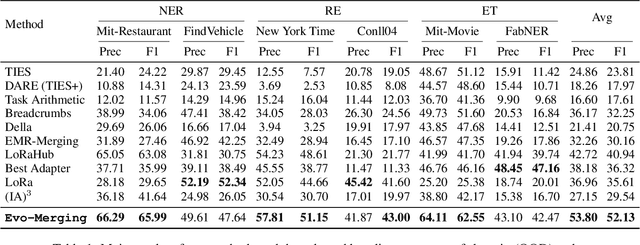
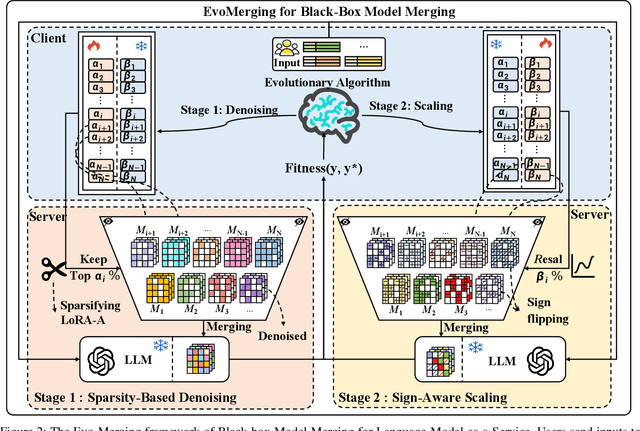
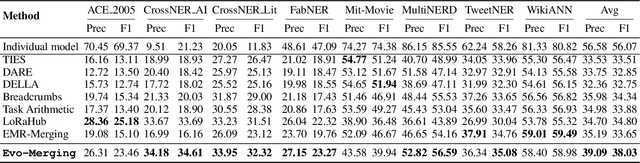
Model merging refers to the process of integrating multiple distinct models into a unified model that preserves and combines the strengths and capabilities of the individual models. Most existing approaches rely on task vectors to combine models, typically under the assumption that model parameters are accessible. However, for extremely large language models (LLMs) such as GPT-4, which are often provided solely as black-box services through API interfaces (Language-Model-as-a-Service), model weights are not available to end users. This presents a significant challenge, which we refer to as black-box model merging (BMM) with massive LLMs. To address this challenge, we propose a derivative-free optimization framework based on the evolutionary algorithm (Evo-Merging) that enables effective model merging using only inference-time API queries. Our method consists of two key components: (1) sparsity-based denoising, designed to identify and filter out irrelevant or redundant information across models, and (2) sign-aware scaling, which dynamically computes optimal combination weights for the relevant models based on their performance. We also provide a formal justification, along with a theoretical analysis, for our asymmetric sparsification. Extensive experimental evaluations demonstrate that our approach achieves state-of-the-art results on a range of tasks, significantly outperforming existing strong baselines.